https://eurydice.eacea.ec.europa.eu/news/estonia-ai-leap-initiative-enhance-learning-and-teaching
## GPT had been out for five months
That’s a very long time ago. GPT had been out for five months. It was in November 2022, and I became a minister in April 2023 and my advisor came to me and said, “Dear Minister, I think we need to do something about AI.” And I said, “Okay, what should we do?” And he says, “I’m not sure.”
## AI was not on the agenda
So another two months, we start working on different policies that we had to develop. This was our agenda but AI was not on the agenda when I became a minister. This is something I didn’t think about, but it was there.
## I still don’t know
So two months later, my advisor comes to me and says, “I think still that we need to do something about AI, because students are already using it in schools.” And I said, “Fine, what do we do about it?” And he says, “I still don’t know.”
## The smarter people
So what we did was that we went to the smarter people, people who actually knew something about AI, and we had a lot of rounds of meetings and discussions with neuroscientists, with cognitive scientists, with tech companies, with IT people, to just, to figure out how is AI going to affect the education and learning, and what should we as policymakers do about it.
And what we came up with was that it’s not about technology. We don’t have to care about the technology, because the technology is part of the other discipline. We as a, me as a Minister of Education, I have to care about the learning, what happens to the learning, to the human brain, and the human capacity to learn, if the technology advances to the stage where it was already back then.
## Two-thirds of the workforce
So my question was then, when AI is here, and when AI is so magnificent, then what is something that we have to do in education system for the humans of next generation? But it’s not a new question, because back in 2017 already, OECD, which is an international organization on economic cooperation did a survey of skills, labor skills, the workers in the, in the workforce, and they found out that two-thirds of the workforce already at that time had a literacy and numeracy and digital skills lower than the computers at that time.
## Should we actually give up learning altogether?
So human capacity to think, to analyze, to calculate, to functionally read and understand the text was already lower when compared to the computers at that time. So that was a very big question to the education system. what about the humans? Should we actually give up learning altogether?
## What is exactly the education then for
Why would we need to develop our brains and our capacity to think, to analyze, and many other things, if there are computers who can do this, that can do this. Like, what is exactly the education then for? And that’s a, that’s a, that’s a very big question.
## Under the true evolutionary pressure
So we were struggling with this question for almost a year, uh, in the ministry, when we were discussing with the experts about this, and we came to the realization that it’s not the first time in human history when the technology puts humans under the cognitive pressure, under the true evolutionary pressure.
One time when it was happening was when the printing press was invented, when humans, the literacy, the reading skills were not universal, but then the printing press was invented, and what happened to humankind was that every human learned to read. So all the humans actually evolved in a capacity to learn reading.
## A mental, cognitive evolutionary pressure
So what we realized was that after a very long period of time, humankind is again in a very significant evolutionary leap pressure. So we have to evolve. We have to evolve as humans, and the main evolving pressure is our brains. It’s not the ability to stand up and run faster. It’s not a physical evolutionary pressure, but it’s a mental, cognitive evolutionary pressure.
So what we have to do is that we have to think faster, more systematically and much more creatively. Our capacity, our brain capacity has to change, and that’s an evolution, human evolution. Now, the question is, like, where do we find the space for development needed for this?
Some of you, I don’t know if you have neuroscientists or cognitive psychologists in the audience, but you know that our human brain works in two modes. One of them is lower cognitive modes, and the other one is higher cognitive modes. Lower cognitive modes is mostly related to the memory, to the understanding and memorization.
## Like we learn to cycle the bicycle
So, and something that we have automated skills, something that we have learned once and we keep repeating it, and it’s on autopilot all the time, so we don’t relearn it. We just learn, like we learn to cycle the bicycle, or we learn to skate, or we learn to ski, and this is something that we learn, and we don’t relearn every time we sit on a bicycle again, because our brain has just absorbed this skill, and this is something that we apply all the time.
## Our stereotypes
Uh, this is, this is a mode that our brain prefers to be on all the time. So it prefers to be on this lower cognitive mode that we learn once and then we keep repeating. Our stereotypes, for example, come from that lower cognitive mode.
## Italians are loud
We learned that Italians are loud, and then we expect every Italian to be loud every time we meet them, because that’s how our brain operates. just, we just don’t relearn every time we meet an Italian. We have to relearn the person. had lots of talks before here, how we have to learn actually out of box. But, but most of the time, our brain prefers to be on a lower cognitive mode.
## Higher order thinking
Higher order thinking, or higher cognitive mode, is when we have to constantly be in a learning mode, like we have to relearn all the time. The thing that we learned yesterday is not something that we use today. In the situation, in a situation where we are today, we have to learn again. We have to relearn again, use our base knowledge to, to learn a new situation.
## It takes less energy for brain
Why do our brain prefers to be on a lower cognitive mode is because it takes less energy for brain to operate in a lower cognitive mode. Brain is our biggest organ that takes the biggest share of our body energy, so it’s the biggest energy consumer of our bodies. So we prefer to be on a lower mode all the time, because it’s a least energy consuming.
## You will be dead next day physically
If we have to relearn all the time, then it takes a lot of energy. So if you, if you study for a very complicated exam, you will be dead next day physically, because your brain was for 24 hours in a very high cognitive mode, and it took all your energy from your body, so you need to really sleep, you really need to rest, because, because the energy was taken out.
## That’s not an option
It’s much more difficult than running a marathon, which is a physical exercise, in a lower cognitive mode. So human brain is more, more the time in the lower cognitive mode. In an AI era that we are living in, that’s not an option any longer to be constantly on a lower cognitive mode. That’s not an option.
## The lower cognitive thinking skills
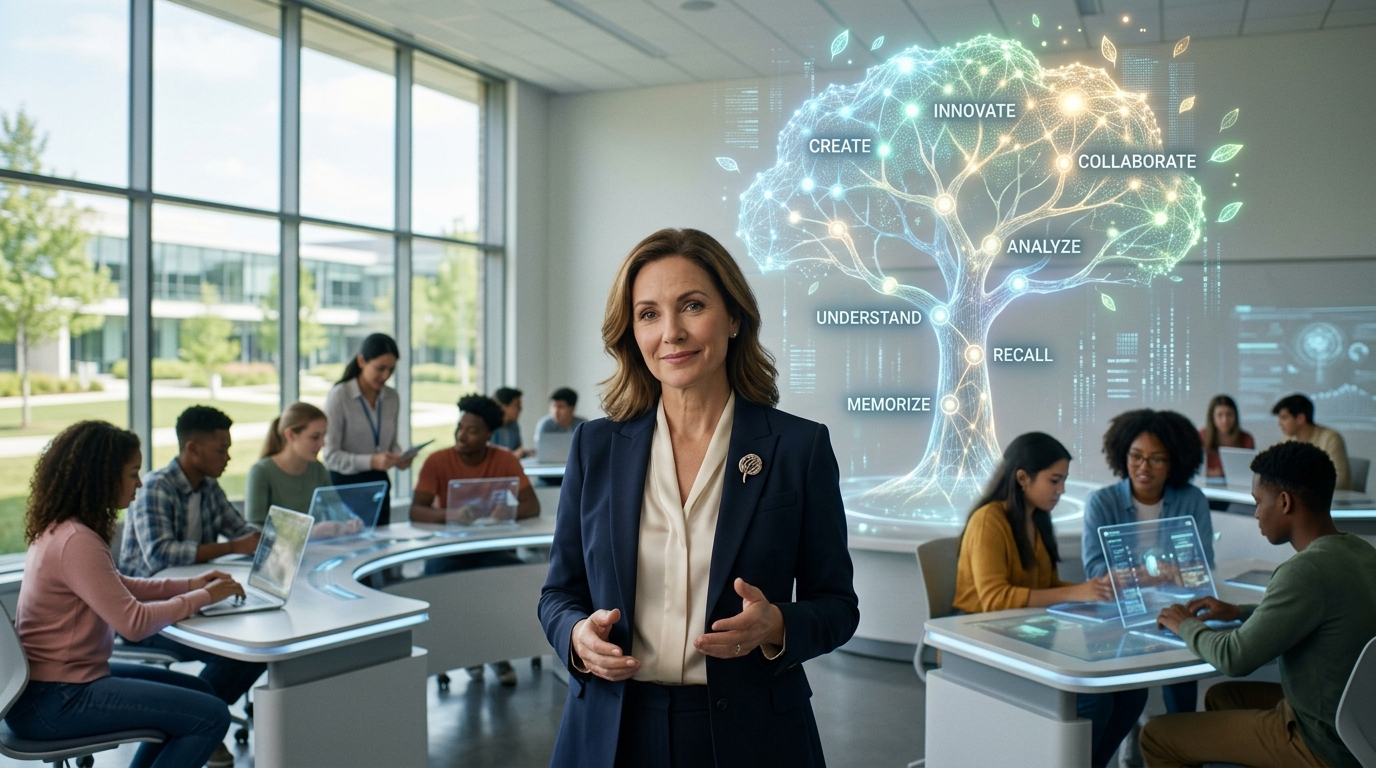
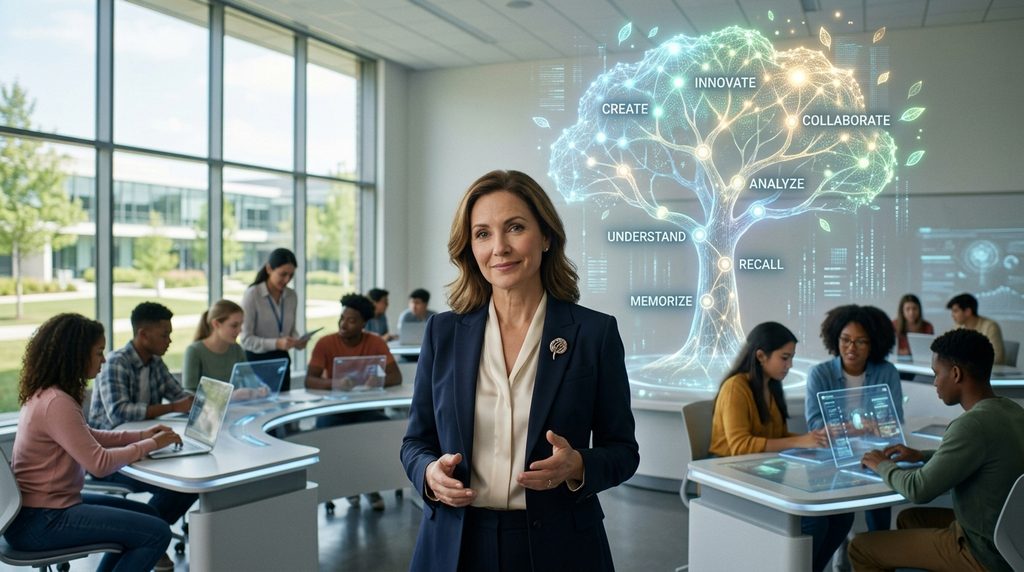
We have to train our brain to be much more often, much more awake hours in a higher order thinking skills. And here is this cognitive, um, tree that you see. The lower, lower cognitive thinking skills is remembering, just a memory, just memorizing something, understanding what you have just memorized, and applying it, as I said, like a bicycle.
## Second World War started in 1939
You learn to ride a bicycle, or you learn that Second World War started in 1939, and then you understand it, and then every time somebody asks you, you just automatically say it. You don’t think any more about this. So this is, this is like lower cognitive thinking skills.
## Analyzing all the time
The higher order thinking skills is analyzing all the time. Why did it start 1939? What were the reasons? Who are the actors? Why, why did they do that? You have to put the different actors together, think about their relationships, think about the actions, the motives behind it. So this is much more complex process.
## Being constantly in the new situation
Also evaluating, giving assessment, having an ethical evaluation on certain things, this is higher order cognitive thinking, and creation, being constantly in the new situation, in a new environment, in a new, new, new situation. That’s, that’s also something that makes your brain very tired, because it takes a lot of energy.
## Throughout 200 years
Now, education systems throughout 200 years have mostly focused on lower order thinking skills. You know, learn something, remember, understand, apply, and then you do the test. The teacher was going to check whether you have actually understood it, whether you have understood it or not, whether you have, you are analyzing it, how you use it in a new situation, how you create something new out of this.
## Only when you get to the PhD and research
Education systems are not really going that far. They are most of the time going to this remembering, understanding, applying. Only when you get to the PhD and research, that’s when you get to this higher order cognitive thinking skills.
## The human creation is completely something else
Now, with an AI, AI is capable of doing all this that is here, with a few exceptions, that they are not very good at doing evaluation and creation, ethical evaluation of the things, or creating new realities. They are, they are capable of doing creating new realities only out of statistical probability cases, but the human creation is completely something else.
## Human brain is still unique
Human brain is in this sense still unique, and what we understood is that in education system, it’s no longer enough to stop education when they’re applying aspect of knowledge is. So it’s not enough anymore to just memorize something, understand something, and then apply it, and then that’s it.
## This is a human brain training
Education systems have to evolve into higher order cognitive skills. So the result is that we have to consciously train humans, and as many people as possible, to be constantly in the flow of this higher cognitive thinking processes, and this is a human brain training. You just train human brains into this.
## The training starts in education system
Of course, the training starts in education system, so training of higher cognitive processes starts in school, and it’s not long just in PhD. You have to do it already in a lower secondary, higher, upper secondary, BA, when you do the BA studies, and so on.
## The seventh graders
So you come to the lower secondary, in case of Estonia, that’s the seventh graders, that’s 12-13-year-old kids. That’s when you really have to start already in the curriculum and in the teaching applying, analysis, evaluation, and creation.
## AI as a tutor and assistant
But we realized that we have to do it with AI as a tutor and assistant in it, because the AI is the one that pushes us to do those things. Without AI, we kind of leap back to the usual lower cognitive thinking of memory, understanding, applying.
## We decided to introduce AI to the schools
So we decided to introduce AI to the schools, into the schools, to give licenses of, to the students, and train the teachers how do you integrate AI into the learning process, so that it pushes you to do more analytical thinking, more systematic thinking, and more creative thinking and critical thinking.
## An AI Leap program in February 2025
So the wise people around me that I talk to a lot, they created AI strategy for Estonian schools in 2024, by the end of 2024, and we started an AI Leap program in February 2025. So we are in the first pilot year. We started only with the upper secondary schools.
## Private-public partnership
The program is private-public partnership, because half of the budget comes from the private sector companies that are investing in this, and half of the budget from the ministry. It’s outsourced as a task to the foundation. It’s not run by the ministry.
## Vocational education students
There are various reasons why ministry is not the best place to do such innovative initiatives, and we launched it, as I said, on 10th and 11th grade students, and in 2026, September, we will be extending it to the vocational education students.
## The absolute focus is on teacher competencies
The absolute focus is on teacher competencies, to understand teachers, that how they use AI to bring students to do more analytical thinking and systematic thinking in their assignments and exercises. So teachers are absolutely focused on this.
## Socratic-style tutoring AI tool
We use Socratic-style tutoring AI tool. This is something that we developed together with the OpenAI. I have to say, OpenAI has been extremely good partner for us to do an R&D work on the tool that we want to use at school. It’s not the general-purpose ChatGPT. It’s actually a Socratic version of GPT for schools.
## We are really observing and learning
We do scientific monitoring, but we also don’t know much what is going on. We are really observing and learning as we go along, because there are no clear answers or fixed answers yet. There is very little science that we know about it.
## Brain rot and cognitive offloading
So Estonia is first and so far the only country that has given this kind of Socratic tool to students to study with, and everybody, of course, is watching us, but we are asking everybody to come along and learn with us, because we were most afraid that if we don’t do anything, then there will be a brain rot and cognitive offloading and all these kind of things, because education system will go based on inertia only on those cognitive processes.
## How we use it and why we are using it for
So, as our president said when we launched this, um, uh, this initiative, it’s not about using AI the most. It doesn’t have to be the hours we use. It’s about how we use it and why we are using it for.
## Let’s use it the wisest way
So let’s use it the wisest way, and I think we are producing knowledge, scientific knowledge, out of this project as well, that I think world is waiting and wants to know how the AI is affecting the human learning process itself.
