https://www.coursera.org/articles/what-is-generative-ai
Generative Artificial Intelligence
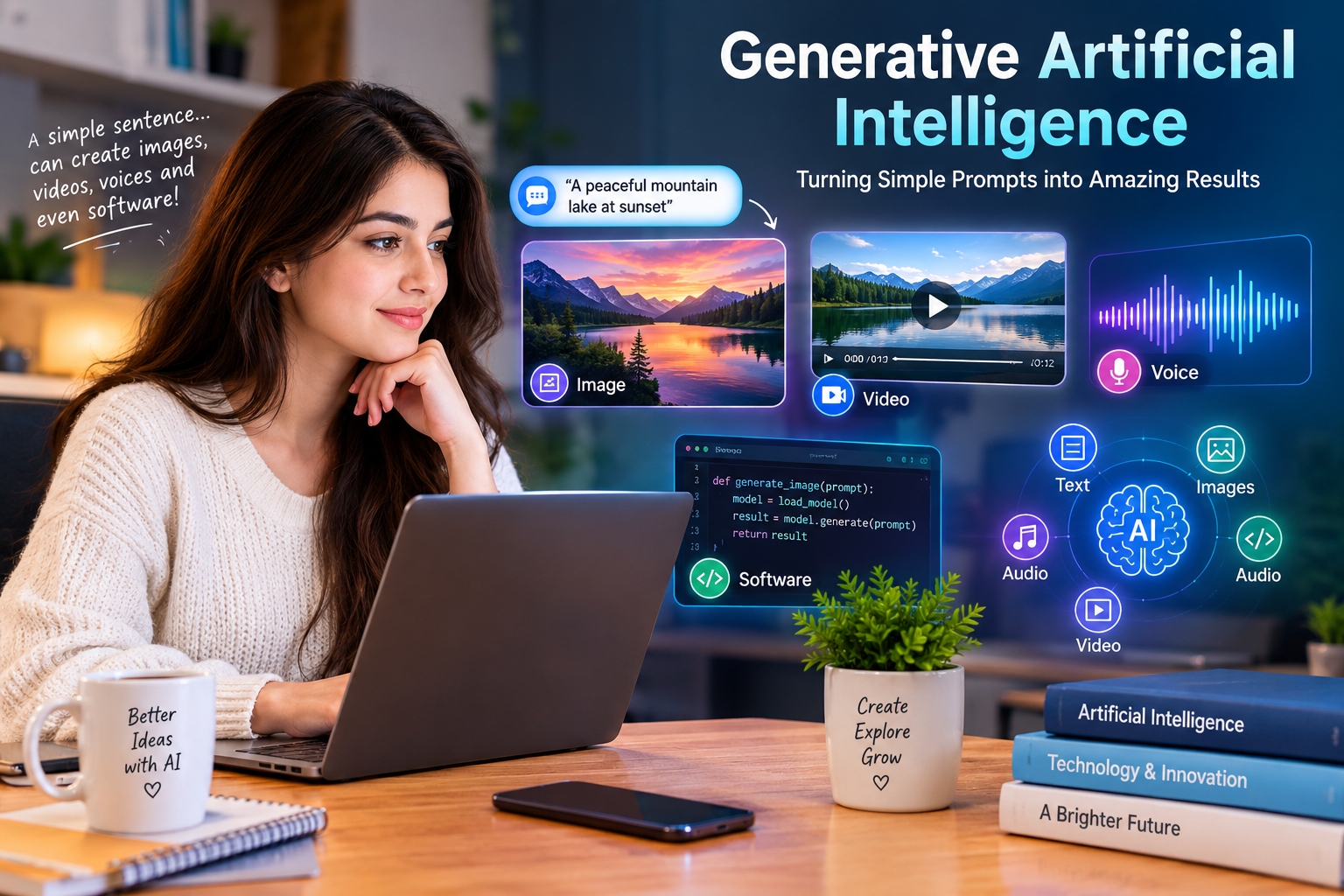
How can a simple sentence become a realistic image, video, voice, or even an entire piece of software? Generative artificial intelligence makes this possible. Conventional artificial intelligence typically focuses on recognition and prediction, while generative artificial intelligence creates new content.
At the most basic level, users can turn a simple sentence into a new image or video with the right tools. But how does this process actually work? Generative artificial intelligence systems learn from vast amounts of data. During training, these systems learn the statistical patterns within the data.
Parameters within Deep Neural Networks
Deep neural networks contain millions of parameters. During training, the system continuously fine-tunes these parameters. After training, the model can apply what it has learned to new inputs.
The model then analyzes relationships between tokens and the context of a user’s request.
Predict and Calculate
The model uses the patterns it learned during training to predict and calculate the most likely response. These processes happen so quickly that users often feel as though the system responds instantly.
However, generative artificial intelligence does much more than interpret text.
A Blank Canvas for Image Creation
Many image-generation systems start with something similar to a blank canvas. In practice, they begin with a field of visual noise and gradually transform that noise into a meaningful image based on the user’s prompt.
Images and Prompts Can Become Videos
Video models must learn how objects look and how those objects interact with one another. They also need to understand movement, space, and visual relationships.
Consistency Between Components
Consistency plays one of the most important roles in video generation. The model must maintain the same characters, objects, lighting, and environment throughout the video.
A good video model generates realistic objects and movements while also creating natural camera movements. Ultimately, these systems aim to create complex video content from a simple user prompt.
Generative artificial intelligence can also create realistic-sounding voices.
Words Transform Into Speech
Text-to-speech models transform written words into spoken audio. Generative models can therefore support many applications, including audio production, video editing, and music editing.
But how else can generative artificial intelligence help people?
The Creator Provides the Concept
Generative artificial intelligence has become an important tool in software development. Developers can use AI to help create and improve software.
Businesses can also use generative AI to summarize and organize documents. Students can use these systems as educational assistants.
Across many industries, generative artificial intelligence continues to grow as an important productivity tool. However, this technology also creates several challenges.
Artificial Intelligence Can Be Inaccurate or Incomplete
AI systems can sometimes produce inaccurate, incomplete, or misleading information. Users must therefore pay close attention to privacy, security, intellectual property, and ethical concerns.
People should review AI-generated content carefully before they use or publish it.
Generate Valuable and Reliable Content
The goal of generative artificial intelligence should not simply involve creating more content. Instead, users should focus on creating valuable and reliable results.
AI developers continue to improve these systems to address accuracy and reliability challenges. One major trend involves multimodal artificial intelligence systems. These systems can understand and work with different types of information at the same time.
Multimodal Artificial Intelligence Systems
Generative artificial intelligence could become even more closely connected with robotics and other technologies. AI is already moving beyond simple question-and-answer systems toward truly multimodal systems.
These systems can understand and process text, images, audio, video, and other forms of information.
AI Agents Will Be Able to Perform More Involved Tasks
AI agents will eventually perform increasingly complex tasks for people. These systems could transform workplaces, education, entertainment, transportation, and many other industries.
Let’s review the key points.
A Human Provides a Prompt to the AI
A human gives the AI a prompt or input. The system then applies the patterns and parameters it learned during training.
The AI generates new data in many different forms, including text, images, video, audio, and software. A human can review the generated content, make changes, and guide the system toward the desired result.
Generative artificial intelligence continues to become one of the most important tools of the modern digital age. Follow New AI Technology USA to keep up with the latest trends in artificial intelligence.