## Ready to Prove Yourself
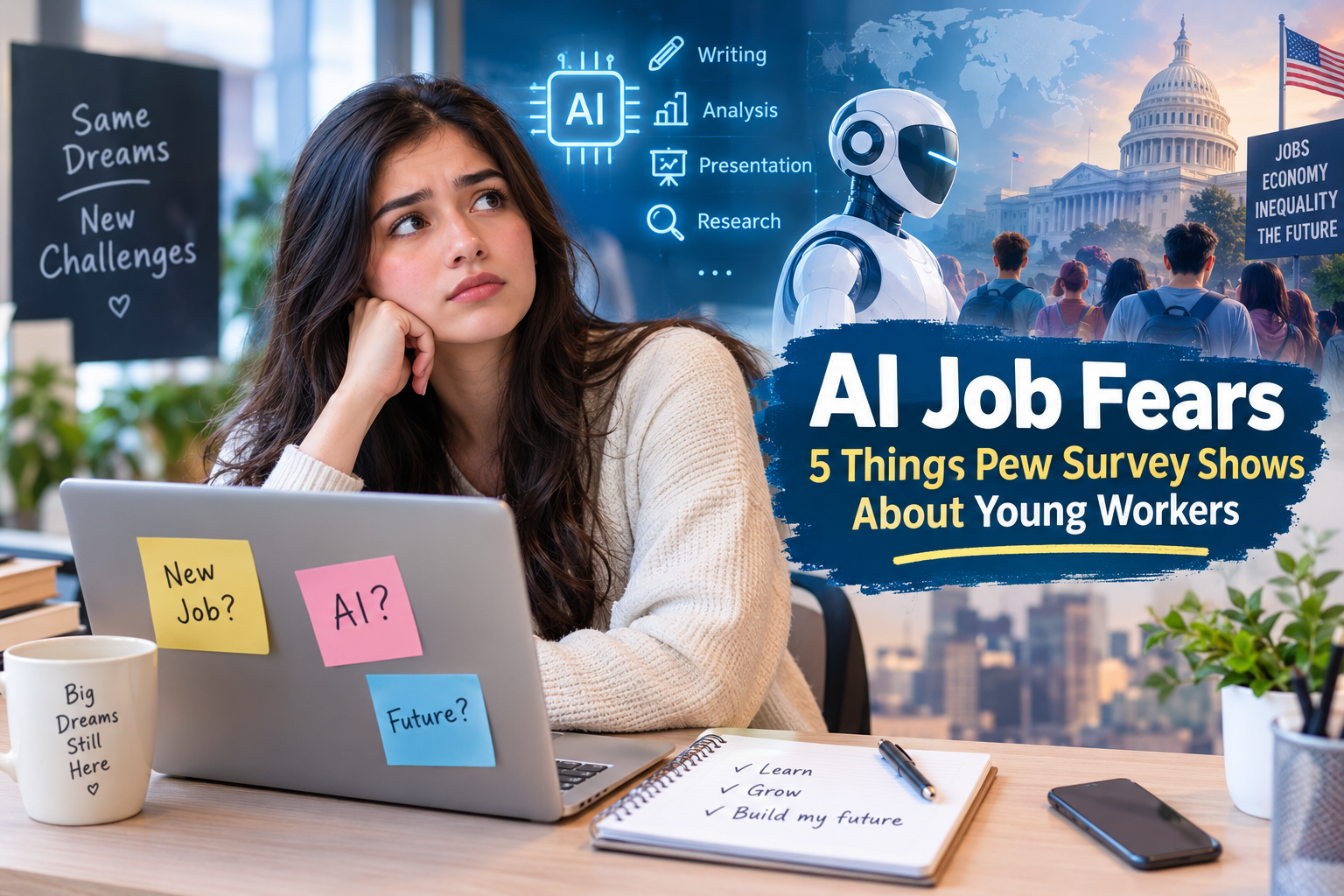
New ID card, new boss, new colleagues. You’re excited, nervous, ready to prove yourself. Then someone says, “Don’t worry. We have AI for that. Writing, AI, analysis, AI, presentation, AI, research, AI again,” and suddenly you’re wondering if you know something the machine doesn’t.
## A New Global Survey by the Pew Research Center
That’s actually part of a new global survey by the Pew Research Center on the anxiety and enthusiasm of young people around the world towards AI. And it turns out that in several countries, young people are more likely than older people to expect AI to reduce jobs. India is one of them. Here are five things the survey tells us.
## Number one, young people are worried.
Number one, young people are worried. That’s the irony. People that grew up with smartphones, social media, chat bots, are among the most concerned about what AI will do to their careers.
## People entering the workforce now
In India, Canada, France, Singapore, Sweden, Indonesia, and Malaysia, people aged 18 to 34 are more likely than those aged 50 and above to say that AI will lead to fewer jobs. And this is people that are entering the workforce now.
## A pretty uncomfortable career plan
They’re applying for their first jobs, building their CVs, pays off their student loans, trying to get promoted, and as they are learning how to do the job a machine is just standing in the way. That is a pretty uncomfortable career plan if you ask us.
## 73% of Americans aged 18 to 29
In the United States, the shift is particularly clear. The Pew survey found that 73% of Americans aged 18 to 29 now expect AI to lead to fewer jobs over the next 20 years. That’s up from 61% in 2024.
Number two, the fear is bigger than job security. Because there is another question lurking under the AI boom. Who gets rich from it and who gets left behind? Young Americans are particularly worried that AI could widen the gap between the rich and the poor.
## It could create entire new industries
That concern is also visible in Australia, Canada, Poland, and Singapore. And that makes sense. AI could make a company more productive. It could help one worker do the job that once required three. It could create entire new industries.
Someone has to decide where the extra money goes. To the worker, the shareholder, or the machine that did the work.
## A lot of very unproductive payslips
Because if AI creates more value but fewer paychecks, we may end up with a very productive economy and a lot of very unproductive payslips.
## Young people are not anti-AI
Number three, young people are not anti-AI, and this is very important. The Pew survey does not show a generation running away from artificial intelligence. It’s actually the exact opposite. Young people are among the most aware of it, and their feelings are complicated.
Across the 37 countries surveyed, a median of 41% say that they are both concerned and excited about AI. Another 37% are more concerned than excited. And among people under 35, mixed feelings are particularly common.
## AI is both things
And that’s probably actually the most honest response because AI is both things. It can help understand, help students understand calculus, help a designer brainstorm, help a small business write marketing copies.
## The richer the country the bigger the job fear
Number four, the richer the country the bigger the job fear. Pew found that concerns about AI-driven job losses are generally higher in wealthier countries. In 18 high-income countries, a median of 55% expect AI to lead to fewer jobs over the next 20 years.
## Where AI is more advanced
In 18 middle-income countries, that figure is 36%. In Australia, South Korea, and the United States, around seven in 10 or more adults expect AI to reduce jobs. And then there is an interesting reason why fear may be higher where AI is more advanced.
## They’re afraid of one they can already see working
People are not afraid of a technology they’ve never seen. They’re afraid of one they can already see working. There’s not just one survey or report that mentions the fears of AI.
## Jobs obsolete according to a Gallup survey
That’s up from 20% last year and from 13% when Gallup first asked the question in 2017.
## College-educated workers expected to control
The concern is also rising among college-educated workers, which is significant because for years technology was something many white-collar workers expected to control. Now they’re wondering if they are the ones being controlled by it.
A survey by rumbuilder.com of business leaders in the United States found that 94% of the respondents expected to reduce headcount as AI takes over more functions.
## But it does reveal the incentive
92% said AI investment was a higher priority than employee satisfaction. Now that’s a business leader survey, not a forecast for an entire global economy. But it does reveal the incentive.
## Companies have a reason to automate
Companies have a reason to automate. AI does not ask for a raise. It does not take a weekend off. It does not send a passive-aggressive email saying, “Just circling back.”
## Whether society changes with it
The question is not whether AI will change work. It already is changing work. The question is whether society changes with it.
## What businesses do, what governments do, what schools teach
Or does it mean one person can do more and create something new? And that depends on what businesses do, what governments do, what schools teach, and whether workers are given the skills to move into the jobs that AI creates because technology has always destroyed some jobs.
## The difference this time is the speed and the scale
The difference this time is the speed and the scale. AI is not waiting for the next generation to arrive. It is arriving with them. And that’s why the youngest workers are not just cheering for the future.
## One eye on the opportunity
They’re looking at it with one eye on the opportunity and the other on their payslip.
## Hit the like button and subscribe
And if a story stood out to you, drop us a comment. and what you’d like to see us cover next.
## The elections the world is watching
USA, USA, USA. The elections the world is watching. America is heading for a political showdown. With a country split down the middle and the world holding its breath, the 2026 midterm elections will decide who controls Congress and how much power Donald Trump has left to wield.
## Every swing state is a battlefield
Will Republicans hold the line in the House and Senate, or will Democrats storm back from the political wilderness? Every swing state is a battlefield. The rising cost of fuel, inflation, immigration, conflicts abroad, and the presidency under pressure.
## Stay with us here on First Coast America
These are the issues that will matter the most. We’ll bring you the biggest stories, the sharpest analysis, the players that will decide America’s next two years, and track the race that will decide the winners and the losers. Stay with us here on First Coast America.
But headlines are only the beginning because behind every story there is context.
## Take on the world
There are consequences, and there are questions worth asking. Find the answers. Understand the story. Take on the world.
Every heading is a phrase taken word for word from the paragraph under it, with title-case capitalization as the only change. Two headings (“Jobs obsolete according to a Gallup survey” and “College-educated workers expected to control”) join words from different parts of the same paragraph, so you may want to shorten them to a single phrase if you need them strictly continuous.