https://builtin.com/artificial-intelligence/artificial-intelligence-future
By 2026, technology is accelerating toward a breaking point that has left many working people completely unprepared. Seven specific technologies are driving this transformation. Companies have already deployed these technologies to handle real jobs, and they can often complete those tasks faster and more cheaply than the humans who performed them just two years ago.
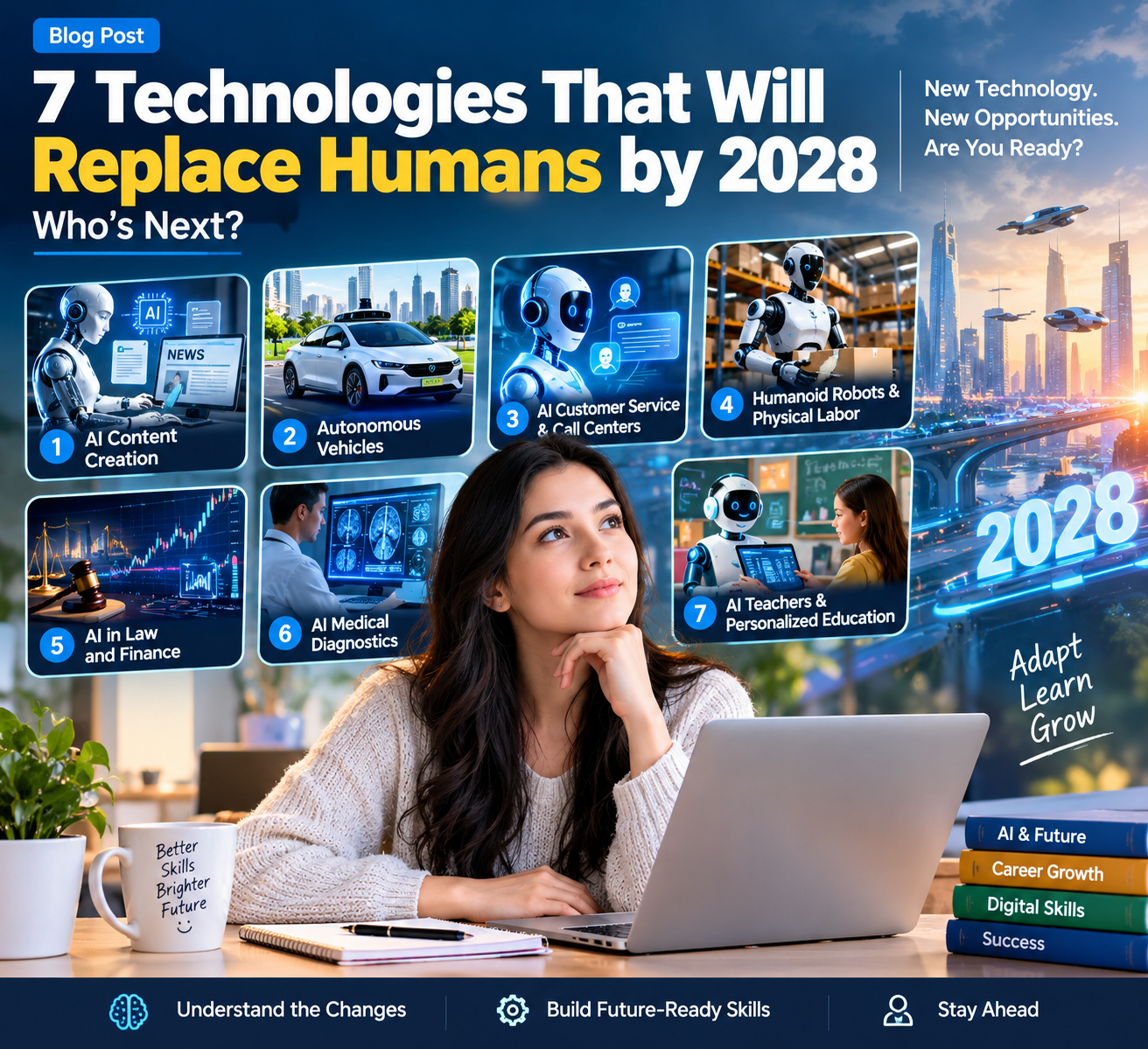
These Are the Top Seven Technologies That Will Replace Humans by 2028
Some of these technologies may surprise you. One of them may already operate inside the company where you work. If you have a job or someone you love has a job, you need to understand what these technologies can do. These are the seven technologies that could replace or significantly reduce human roles by 2028.
AI Content Creation
Technology number one: AI content creation.
AI now writes and produces many types of content.
Real Articles, Published to Real Readers
The Associated Press, Reuters, and Bloomberg already use AI to produce thousands of articles and reports. These include earnings reports, sports results, weather updates, and other routine stories. Readers see these articles every day, and AI can produce many of them without a human writer creating the first draft.
The change extends far beyond news.
Marketing Agencies Are Replacing Copywriters
Marketing agencies increasingly use AI to handle routine copywriting. E-commerce companies use AI to create product descriptions, while law firms use AI to draft standard documents.
A team of writers might once have spent an entire week creating an email campaign. Today, one person can use an AI tool to complete a similar task in about 40 minutes.
If your job involves writing routine content, reports, emails, product descriptions, or standard documents, AI can already automate some of your responsibilities.
The People Who Survive This Shift
The people who adapt to this shift will not necessarily write the fastest. Instead, they will learn how to direct AI while adding human judgment, creativity, critical thinking, and relationships that AI cannot easily replicate.
Technology number two: autonomous vehicles.
Self-driving vehicles and autonomous delivery systems are changing transportation. Millions of drivers work in the United States and the United Kingdom, and companies continue developing technology that could eventually perform many of their tasks.
Fully Driverless Taxis on Public Roads
Waymo already operates driverless taxi services on public roads in places such as San Francisco and Phoenix. Passengers can use the service without a human driver sitting behind the wheel.
This technology has moved beyond laboratory experiments and into commercial transportation.
No Rest Stops, No Shift Limits, No Overtime
Amazon has deployed thousands of autonomous robots across its warehouse operations. Tesla continues developing and testing its Full Self-Driving technology, while Uber Freight works on autonomous trucking solutions.
Autonomous vehicles can operate continuously without needing traditional driver breaks, hotel rooms, lunch breaks, or overtime.
An Autonomous Truck Does Not Need a Hotel Room
An autonomous truck does not need a hotel room after a long drive. It does not need a lunch break, and it does not become tired at 2 a.m. on a long highway route.
These advantages could make autonomous transportation increasingly attractive to companies that want to reduce operating costs.
The Timeline for Disruption Is Shorter
If you work in transportation or know someone who does, you should pay attention to how quickly autonomous technology develops. Companies continue investing heavily in systems that could automate predictable transportation routes.
Technology number three: AI customer service and call centers.
There Are 17 Million Call Center Workers in the United States Alone
Millions of people work in call centers around the world. AI customer-service systems now handle many routine interactions, and companies continue replacing repetitive human tasks with automated systems.
Google Duplex Can Make Real Phone Calls
AI systems can now communicate with customers through voice and text. Platforms such as Amazon Connect and Salesforce Einstein help companies automate customer-service interactions.
These systems can answer common questions, process routine requests, and assist customers without requiring a human agent for every interaction.
This Is Not a Future Projection
Companies increasingly use AI to handle large volumes of customer interactions. When an AI system can handle routine conversations efficiently, a company may need fewer human agents to manage the same workload.
That does not mean every customer-service employee will disappear. Instead, AI will likely handle more repetitive interactions while humans manage complicated or sensitive situations.
The Highest-Risk Category of Any Job on This List
If your job requires you to answer the same questions repeatedly, process identical requests, or follow predictable customer-service scripts, AI could significantly change your role.
Technology number four: humanoid robots and physical labor.
Humanoid Robots and Physical Labor
For decades, companies used robots to perform specific tasks on factory assembly lines. New humanoid robots aim to take that automation much further.
General-Purpose Humanoid Robots
Companies such as Tesla, Figure, and Boston Dynamics are developing humanoid robots that can operate in environments designed for people.
These robots can potentially use human tools, move through human workspaces, and perform different physical tasks instead of focusing on only one isolated operation.
Amazon Already Operates Over 750,000 Robots
Amazon already uses hundreds of thousands of robots across its global warehouse network. The company also continues exploring robots that could perform tasks that its current automated systems cannot handle.
As robots become more capable, companies could use them for picking products, moving inventory, stocking shelves, and performing basic assembly tasks.
The Economics Are Brutal
Companies can operate robots for long periods without paying salaries, benefits, sick leave, or overtime. A robot can potentially work multiple shifts each day and perform repetitive physical tasks without becoming tired.
As robotic technology becomes cheaper and more capable, companies will have stronger financial reasons to automate repetitive physical work.
Physical jobs that involve predictable movements in structured environments could experience the first major wave of robotic automation. Warehouse picking, shelf stocking, and basic assembly represent some of the clearest examples.
Technology number five: AI in law and finance.
This development surprises many people because they often assume highly educated professionals face less risk from automation. AI has started challenging that assumption.
JP Morgan Chase Built an AI System Called COIN
JPMorgan Chase developed an AI system called COIN to review commercial loan agreements. The system can analyze documents that previously required large amounts of lawyer time.
Other AI platforms can also draft contracts, review case law, and help prepare legal documents. Major law firms increasingly use these tools to speed up routine legal work.
Goldman Sachs Replaced 600 Human Equity Traders
Financial companies have also automated many trading activities. Algorithms can analyze enormous amounts of financial data and execute trades far faster than humans can.
As financial institutions expand their use of AI and algorithms, they can reduce the need for people to perform repetitive analysis and trading tasks.
Junior Roles Are Disappearing First
The pattern appears across both law and finance: companies can automate many entry-level tasks before they automate senior responsibilities.
Junior lawyers, financial analysts, paralegals, and researchers often perform document reviews, data analysis, and other repetitive work. AI can handle many of these tasks quickly.
Senior professionals still provide client relationships, strategic judgment, negotiation, and complex decision-making.
If your children or grandchildren want to pursue careers in law or finance, they should prepare for this changing environment. Future professionals will need skills in client strategy, complex negotiation, communication, leadership, and relationship building.
AI Medical Diagnostics
Technology number six: AI medical diagnostics.
Radiologists spend years learning how to interpret medical scans. AI can now analyze many of the same images and identify patterns that humans may overlook.
Google DeepMind’s AI Detected Breast Cancer
Researchers have developed AI systems that can analyze mammograms and identify signs of breast cancer. Other researchers have also developed AI systems that analyze skin images and help identify possible skin cancer.
These technologies show how AI can support medical professionals by analyzing large amounts of visual information.
These Are Not Small Achievements
AI pathology systems can analyze tissue slides and identify patterns that previously required highly trained specialists.
As researchers improve these systems, hospitals may increasingly use AI as an additional diagnostic tool before doctors make final decisions.
Hospitals That Have Not Integrated AI Diagnostic Tools
Hospitals that adopt reliable AI diagnostic systems could gain advantages in speed, consistency, and data analysis.
However, doctors will continue to play an essential role because they must consider a patient’s medical history, symptoms, circumstances, and treatment options.
The Doctor-Patient Relationship
AI can analyze images, slides, and medical data, but doctors still provide something technology cannot easily replace: human connection.
Doctors explain diagnoses, answer difficult questions, understand patient concerns, and make clinical decisions using years of experience.
AI may increasingly handle data analysis before a doctor reviews the results, but doctors will continue guiding patients through their care.
AI Teachers and Personalized Education
Technology number seven: AI teachers and personalized education.
This development may surprise many people because teaching requires patience, empathy, communication, and the ability to understand students.
Patience, Empathy, the Ability to Read a Room
Great teachers know how to encourage students who have lost confidence. They recognize emotional barriers, adjust their communication, and motivate students to keep learning.
However, many everyday teaching tasks involve repetitive explanations, grading, and monitoring student progress.
These Are Tasks That AI Handles with Extraordinary Precision
Teachers often explain the same concept in multiple ways until students understand it. They grade assignments, identify struggling students, and adjust lessons.
AI systems can automate many of these tasks. They can explain concepts repeatedly, provide instant feedback, and track individual learning progress.
Khan Academy’s AI Tutor, Khanmigo
Khan Academy’s AI tutor, Khanmigo, provides students with personalized assistance. It can respond to questions, adjust explanations, and support students at different learning levels.
AI tutors can provide one-to-one assistance at a scale that many traditional schools cannot afford with human staff alone.
Carnegie Learning’s AI System
Carnegie Learning has developed AI-powered educational systems that personalize instruction and help students practice concepts based on their individual needs.
As these systems improve, schools may use AI to handle more standardized teaching and learning tasks.
By 2028, AI will not replace every teacher. Instead, schools may use AI to automate standardized teaching functions and allow human educators to focus more on mentorship, relationships, creativity, and complex student needs.
The Teachers Who Thrive in 2028
The teachers who thrive in 2028 will use AI rather than compete directly against it.
They will build genuine relationships with students, identify emotional and social barriers to learning, motivate children, and help students believe in their own potential.
Those human qualities will remain extremely valuable.
Let us bring it all together.
By 2028, AI writing tools could handle a large share of routine content production. Self-driving vehicles could automate predictable transportation routes. AI customer-service systems could handle many routine interactions.
Humanoid robots could perform more repetitive physical tasks, while AI systems could automate parts of legal, financial, medical, and educational work.
Every Single Technology on This List Is Already Deployed
These technologies do not exist only in science-fiction movies. Companies already use AI writing tools, autonomous vehicles, customer-service AI, industrial robots, legal AI, medical AI, and personalized learning systems.
The technology will continue improving, and companies will decide which tasks they can automate based on cost, reliability, safety, and business needs.
The People Who Will Thrive in 2028
The people who thrive in 2028 will not simply fight technological change. They will understand which parts of their jobs AI can automate and develop skills that complement the technology.
They will learn how to use AI, strengthen their communication and creative abilities, develop better judgment, and build skills that require human interaction.
The best strategy is not to wait until automation reaches your job. Start preparing before that happens.
Subscribe So You Do Not Miss What Comes Next
If this video gave you a clearer picture of the changes ahead, hit like. It takes only a second and helps this channel reach more people who need to understand how technology could affect their careers.
Subscribe so you do not miss what comes next.
Drop Your Answer Below
Now I want to know your opinion: which of these seven technologies concerns you the most? Do you believe AI or automation could replace important parts of your job by 2028?
Drop your answer below.