https://electronics.howstuffworks.com/phones-in-2050.htm
What Will Technology and Entertainment Look Like in 2050?
Imagine Someone Taking Out a Phone in 2050
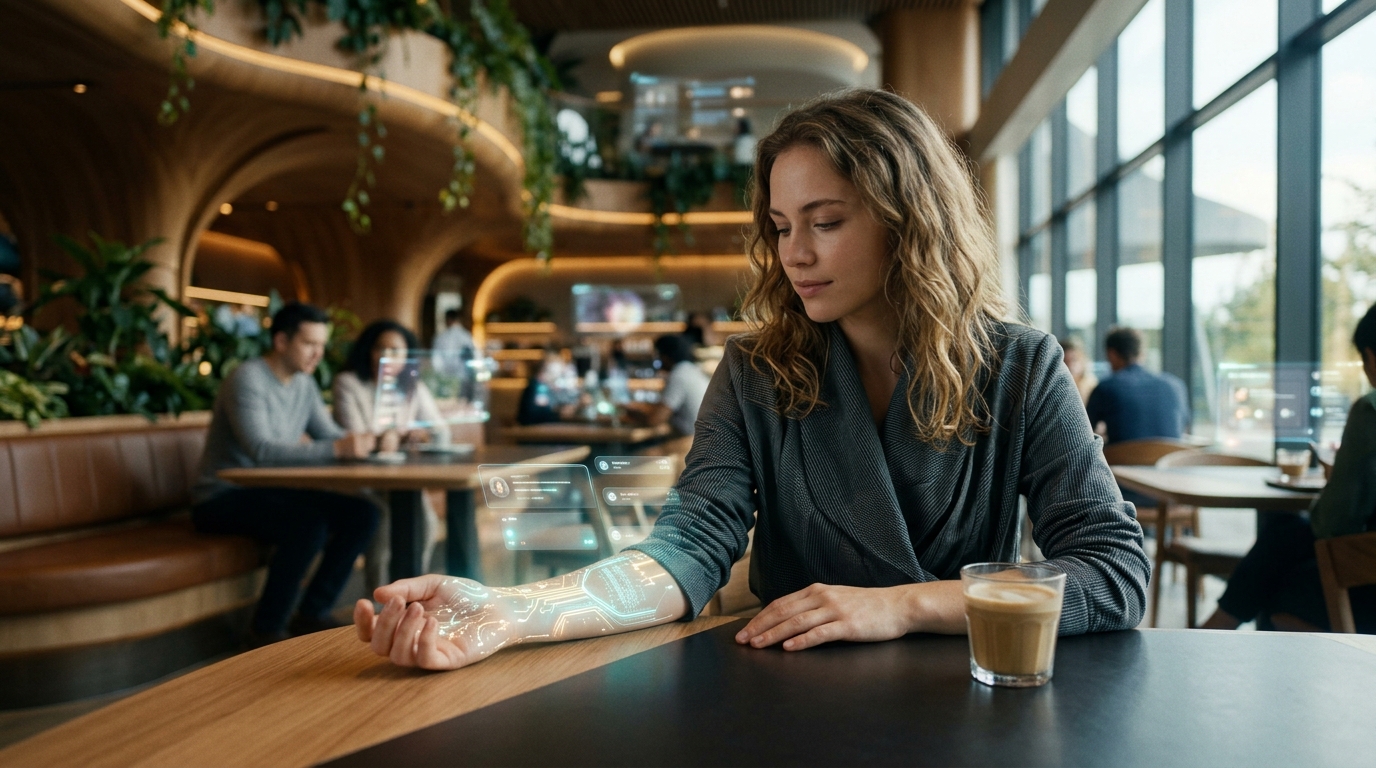
Imagine someone taking out a phone in 2050. Picture a person sitting in a café, reaching into a pocket, pulling out a rectangular piece of glass, and interacting with it. People might stare in disbelief, not because the device looks impressive, but because it looks ancient. By 2050, smartphones may have become a thing of the past.
Electronic Skin That Stretches and Bends With the Human Body
Years ago, researchers at Stanford’s Bao Lab pioneered electronic skin, a thin membrane that stretches and bends with the human body. Meanwhile, researchers at Harvard explored biodigital inks, while engineers at Tokyo Tech developed OLED displays that could potentially sit directly on the skin.
These early experiments opened the door to a future where people could use their bodies as interactive digital interfaces.
My Hand Starts to Glow
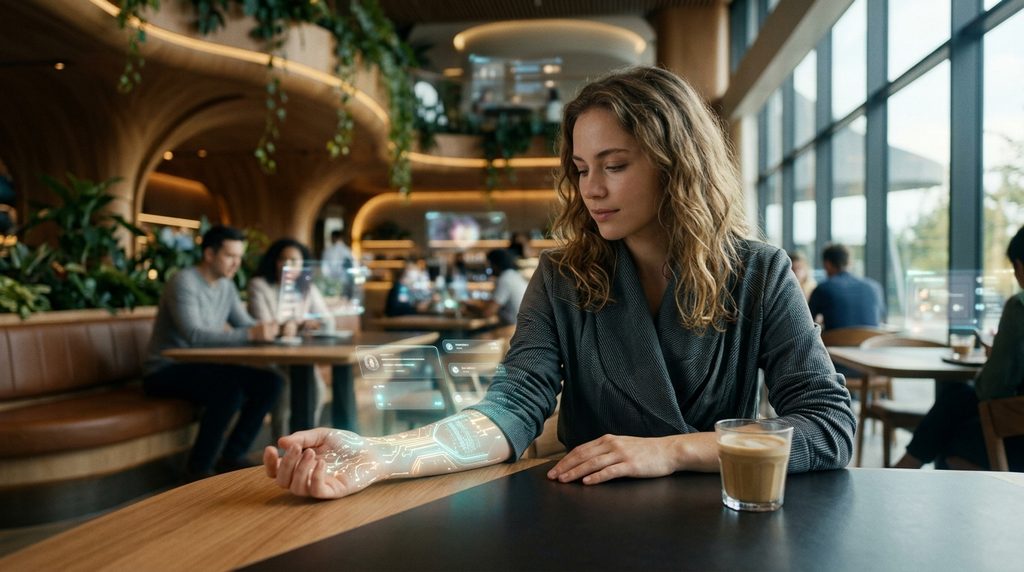
Imagine receiving a message without feeling your phone vibrate. Instead, your hand simply begins to glow. Notifications appear across your skin, your forearm displays a video, and your hand receives a call through a built-in interface. Eventually, you stop thinking about this technology as something unusual.
As technology advances, designers begin focusing on personal expression as much as functionality. Some people wear animated digital tattoos, while others customize their bodies to match their favorite music, clothing colors, or even their heartbeats.
The traditional phone industry gradually loses its importance as people begin using their bodies as their primary digital devices.
The One Problem Technology Still Needs to Solve: Sound
Even after electronic skin replaces traditional screens, one major challenge remains: sound.
For more than a century, people have listened to music through a similar process. Speakers create sound waves, those waves travel through the air, and the waves make our eardrums vibrate. Our brains then interpret these vibrations as sound.
But what if technology could deliver sound without following this traditional process?
What If We Could Send Music Directly to the Auditory System?
Imagine researchers asking a radical question: What if technology could stimulate the auditory system directly instead of relying on sound waves traveling through the air?
Researchers in fields such as neural engineering and auditory neuroscience continue to explore ways to interact with the nervous system. Although direct neural audio remains a complex research challenge, future developments could change how people experience sound.
Most People in 2050 No Longer Wear Headphones
Imagine walking through a train station in 2050. You see no earbuds, AirPods, or oversized headphones. Yet millions of people listen to music throughout their daily routines.
Some people use discreet wearable devices to experience sound without traditional speakers. Others may eventually benefit from advanced technologies that interact directly with their auditory pathways.
The devices might sit behind the neck, inside a piece of jewelry, or within another compact wearable accessory. Rather than producing ordinary sound, future systems could deliver carefully controlled auditory sensations.
A Device That Creates the Perception of Sound
Imagine wearing a tiny device that processes a music file and converts it into signals designed to interact with the auditory system.
Such technology could offer new ways to experience music, although scientists would need to overcome significant biological and engineering challenges before creating a practical consumer product.
Inside My Head, a Live Concert Has Begun
Picture yourself standing in a crowded train station. Hundreds of people talk around you, trains rush past, and commuters move in every direction.
Yet inside your mind, a live concert begins.
You hear every instrument and vocal part with remarkable clarity. You can imagine the sound of a complete orchestra without carrying a speaker or wearing traditional headphones.
Future neural interfaces might create new listening experiences, but researchers still need to determine how safely and reliably such systems could reproduce complex music.
What About People With Hearing Difficulties?
One of the most promising areas of auditory technology involves helping people with hearing difficulties.
Today, hearing aids, cochlear implants, and other assistive technologies already help many people hear or interpret sounds. Researchers continue to improve these systems by developing better signal processing, more effective neural interfaces, and personalized hearing support.
Future innovations could expand these options and help more people access communication, entertainment, and music in ways that suit their individual needs.
Could Our Ears Become Less Essential?
Imagine a future where entertainment no longer depends entirely on sound traveling through the surrounding environment.
Technology could give people new ways to experience music and other audio content. However, natural hearing would still matter, and many people would continue to enjoy conventional speakers and headphones.
This possibility raises another interesting question: If technology can change how we experience sound, could it also transform how we watch videos?
Why do we still need televisions? Why do we dedicate entire sections of our homes to giant black screens when future displays might eliminate that requirement?
During the 2020s, companies such as Light Field Lab and Apple, along with researchers at the University of Tokyo, explored different approaches to spatial displays, augmented reality, and advanced visual experiences.
These technologies could help shape the future of entertainment.
In 2050, Living Rooms May No Longer Need Televisions
Imagine walking into an ordinary living room in 2050. You might not see a television, projector, or any other conventional display.
Instead, a small device sits on a table. It looks no larger than a beverage container, yet it can create an immersive visual experience.
When you start a movie, the device generates a large image that appears to float above the table. You no longer need a giant screen to enjoy a cinematic experience.
A Movie Screen Appears Above the Table
Imagine a compact device directing light into carefully controlled patterns to create a large, three-dimensional visual display.
The image appears to occupy the space above the table, allowing viewers to enjoy entertainment without a traditional television.
Researchers are developing technologies such as light-field displays and spatial imaging systems that aim to create more natural visual experiences. Future advances could make these systems smaller, more affordable, and easier to use.
This Is More Than a Traditional Holographic Projection
The first time you encounter an advanced spatial display, your brain might struggle to understand the image.
You may already recognize holographic effects from science-fiction movies or technology exhibitions. However, many familiar holographic demonstrations rely on projections, transparent surfaces, or carefully controlled viewing conditions.
Future displays could offer a more convincing sense of depth by controlling how light reaches each viewer.
Imagine Watching a Science-Fiction Movie With Realistic 3D Effects
Imagine watching a science-fiction movie as characters appear to step into your living room.
A character might seem to stand beside your chair, while another appears to move around the table. The experience could make the boundary between a movie and the surrounding room feel less obvious.
Unlike conventional flat screens, advanced spatial displays could create images that viewers perceive from different angles.
What Makes This Technology Special?
A conventional television presents an image on a flat surface. A spatial display aims to create a more natural representation of light and depth.
Light-field technology, for example, can direct different light rays toward different viewing positions. This approach can help viewers perceive depth and see changes in an image as they move around the display.
Although these systems still face technical limitations, researchers continue working to make spatial images look more realistic.
Technology Adapts to the Room and Its People
Imagine a living room where technology no longer dictates the furniture arrangement.
Instead of placing every chair in front of a television, family members can sit wherever they feel comfortable. A spatial display can create an experience that suits the room and the people using it.
As people become accustomed to immersive visual technology, traditional flat screens might begin to feel less natural for certain types of entertainment.
Computers Become Almost Invisible
Even the most advanced spatial display needs computing power to process images, run applications, and manage digital content.
For years, researchers have worked to make computers smaller, faster, and more energy-efficient. Technologies such as neuromorphic computing and photonic computing could contribute to this progress.
However, the biggest transformation may involve how people interact with computers rather than simply how small engineers can make them.
Where Is Your Computer?
If someone asks where your computer is today, you might point to a laptop, desktop, or tablet.
In 2050, people might point to a wearable accessory instead.
Researchers and engineers have spent years exploring new computing architectures, including neuromorphic chips that imitate aspects of neural processing and photonic systems that use light to perform certain computing tasks.
Future devices could incorporate some of these technologies into compact wearables that people carry throughout the day.
One Wearable Computer Powers Your Digital World
Imagine a small wearable computing system that coordinates communication, entertainment, artificial intelligence, and personal devices.
Instead of relying on several separate gadgets, you use one central system to connect your digital experiences.
The wearable communicates with compatible devices, processes your requests, and helps you access digital information wherever you go.
This approach could make computing feel less like using a separate machine and more like interacting with an invisible personal assistant.
People Stop Talking About Computer Hardware
In this imagined future, people rarely discuss processors, graphics cards, or computer specifications.
Instead, they focus on what their technology can do for them.
They want faster communication, more immersive entertainment, reliable assistance, and seamless access to information.
As computing becomes integrated into everyday objects, people may care less about the hardware itself and more about the experiences it creates.
A Wearable System Follows You Everywhere
Imagine a wearable device that connects to nearby technology and coordinates your digital environment.
It could help turn compatible surfaces into interactive interfaces, display information when needed, and communicate with a spatial display in your living room.
Rather than forcing you to adapt to a particular device, the system adapts to your surroundings and preferences.
This integration could transform the way people experience entertainment, communication, and everyday computing.
Technology Moves From the Home to the Human Body
In the past, people kept their technology in specific places. Computers sat on desks, televisions occupied living rooms, and phones stayed in pockets or bags.
In this imagined 2050, wearable systems bring many digital functions closer to the body.
People carry their personal computing capabilities wherever they go instead of relying entirely on equipment installed throughout the home.
How Do People Control This Entire System?
Making computers small enough to wear solves only part of the problem. People also need a natural way to control them.
For decades, humans have interacted with computers through keyboards, mice, buttons, and touchscreens.
Each method requires people to perform a specific action to communicate their intentions.
Future interfaces could reduce that effort by interpreting subtle movements and recognizing what users want to do.
Technology Learns to Recognize Intentions
Researchers at Meta Reality Labs and other institutions have explored ways to interpret muscle activity and subtle physical movements.
Engineers are also developing smart fabrics and wearable sensors that can detect body movements and provide information about a person’s actions.
Instead of waiting for a person to complete a movement, future systems could use these signals to predict the intended action.
Such technology could make digital interactions faster and more natural, although accurately predicting intentions remains a difficult technical challenge.
Your Clothes Become Gaming Controllers
Imagine playing a racing game without holding a steering wheel.
You move your body slightly to the left, and the car turns in that direction. You lean right, and the car follows.
First-person shooter games could work differently, too. Instead of pressing a key or clicking a mouse, you make a subtle hand movement that resembles reaching for an object.
Sensors in your clothing or wearable accessories interpret these movements and translate them into commands.
Your body becomes part of the control system.
At First, It Feels Like Magic
Imagine a game that responds to the smallest movement of your hand.
The system analyzes signals from wearable sensors and uses them to recognize your intended action. With sufficiently advanced technology, it might respond before you complete a noticeable physical movement.
This experience could make digital interaction feel more immediate and intuitive.
However, the system would still need to distinguish intentional actions from ordinary movements to avoid mistakes.
Gaming Changes as Players Become More Immersed
As wearable interfaces and immersive displays improve, gaming could move beyond traditional controllers and flat screens.
Some esports competitions might feature players who move around virtual environments, dodge obstacles, and interact with digital objects through physical gestures.
Spectators could watch these competitions through spatial displays or augmented-reality systems.
Traditional gaming would not disappear completely, but new formats could offer experiences that look very different from today’s keyboard-and-mouse competitions.
What Happens When Clothing Replaces the Controller?
Imagine combining wearable computing, electronic skin, spatial displays, and motion-sensitive clothing into one connected system.
Your clothing captures your movements, your wearable computer processes your commands, and a spatial display presents the digital environment.
This integration could reduce the need for separate controllers and conventional screens in certain applications.
However, people would still use physical devices when they offer greater convenience, precision, accessibility, or privacy.
One final challenge remains: Why do people need a screen at all?
Why Do You Even Need a Screen?
For decades, technology companies have made displays larger, thinner, more durable, and more transparent.
Researchers have also explored an entirely different approach: placing tiny displays inside smart contact lenses.
Companies such as Mojo Vision have worked on advanced contact-lens display concepts, while university researchers continue exploring wearable optics and near-eye display systems.
These experiments point toward a future where digital information could appear directly within a person’s field of vision.
Miniature Displays Could Change How People See the World
Smart contact lenses face significant engineering challenges, including power supply, heat management, eye safety, display resolution, and wireless communication.
Researchers must overcome these challenges before such lenses can become practical everyday devices.
In an imagined 2050, however, technological progress has made comfortable, lightweight near-eye displays much more accessible.
People can access digital information without carrying a phone or wearing a conventional headset.
A Digital World Appears Within Your Field of Vision
Imagine walking down a busy street while wearing smart contact lenses.
You blink or make a specific eye movement, and your lenses activate a digital interface. Information appears within your field of vision without requiring a physical screen.
Other people may not notice that you are interacting with digital content because the interface sits directly within your visual experience.
The technology could allow people to access navigation, messages, entertainment, and virtual objects while continuing to see the physical world.
A Movie Theater, Virtual Game, and Concert Appear Before Your Eyes
Imagine viewing a cinema-sized movie without entering a theater.
You could play an immersive virtual-reality game in a large digital environment or watch a virtual concert appear above a real street.
Each person could experience a different digital scene while standing in the same physical location.
Near-eye displays could personalize these experiences by presenting digital images directly to individual viewers.
However, future systems would need to address distraction, privacy, safety, and the risk of obstructing important real-world information.
The Digital World Adds to the Physical World
Imagine walking through a city where digital experiences complement the physical environment rather than replace it.
A person watches a sports match, another explores a fantasy game, and someone else follows navigation directions.
All three people share the same streets and buildings, but their digital interfaces show different information.
Augmented reality could make this possible by placing digital content within a person’s view of the real world.
The physical environment remains shared, while the digital layer becomes personal.
The Physical World Is Shared, but the Digital World Is Personal
Walk through a city in this imagined 2050, and you might see people enjoying different forms of entertainment at the same time.
One person watches a football match through smart lenses. Another plays an interactive science-fiction game. Someone else explores a virtual art exhibition while walking through a public space.
Each person experiences a personalized digital environment without necessarily changing what other people see.
This combination of shared physical spaces and individualized digital experiences could reshape entertainment, communication, education, and public life.
These Changes Eventually Feel Normal
At first, these technologies might seem strange or even overwhelming.
People once needed time to adapt to smartphones, touchscreen interfaces, and wireless headphones. Today, many people use these technologies without giving them much thought.
The same process could happen with future wearable devices and immersive digital environments.
As people become familiar with new interfaces, they may begin treating them as ordinary parts of everyday life.
However, adoption would depend on affordability, comfort, accessibility, safety, and whether people actually find these technologies useful.
The Ultimate Goal Is to Make Technology Feel Invisible
Perhaps the most fascinating part of entertainment in 2050 will not be the technology itself, but how naturally it fits into daily life.
Electronic skin could make personal interfaces feel like part of the body. New audio technologies could change how people experience sound. Spatial displays could reduce the need for televisions, while wearable computers could connect different digital experiences.
Smart contact lenses and motion-sensitive clothing could create even more natural ways to interact with digital content.
The goal would not necessarily be to eliminate every phone, screen, headphone, or computer. Instead, technology could become more personal, adaptable, and less intrusive.
Your skin could become an interface, your surroundings could become a display, and your movements could become commands.
Technology would not disappear. It would move closer to the way people live, think, communicate, and experience the world.
And perhaps that will be the most remarkable change of all.
Thank you for reading. If you want to explore more ideas about how technology could transform everyday life in the future, keep following our articles.