https://www.visionaryartcollective.com/blog/art-of-the-digital-age
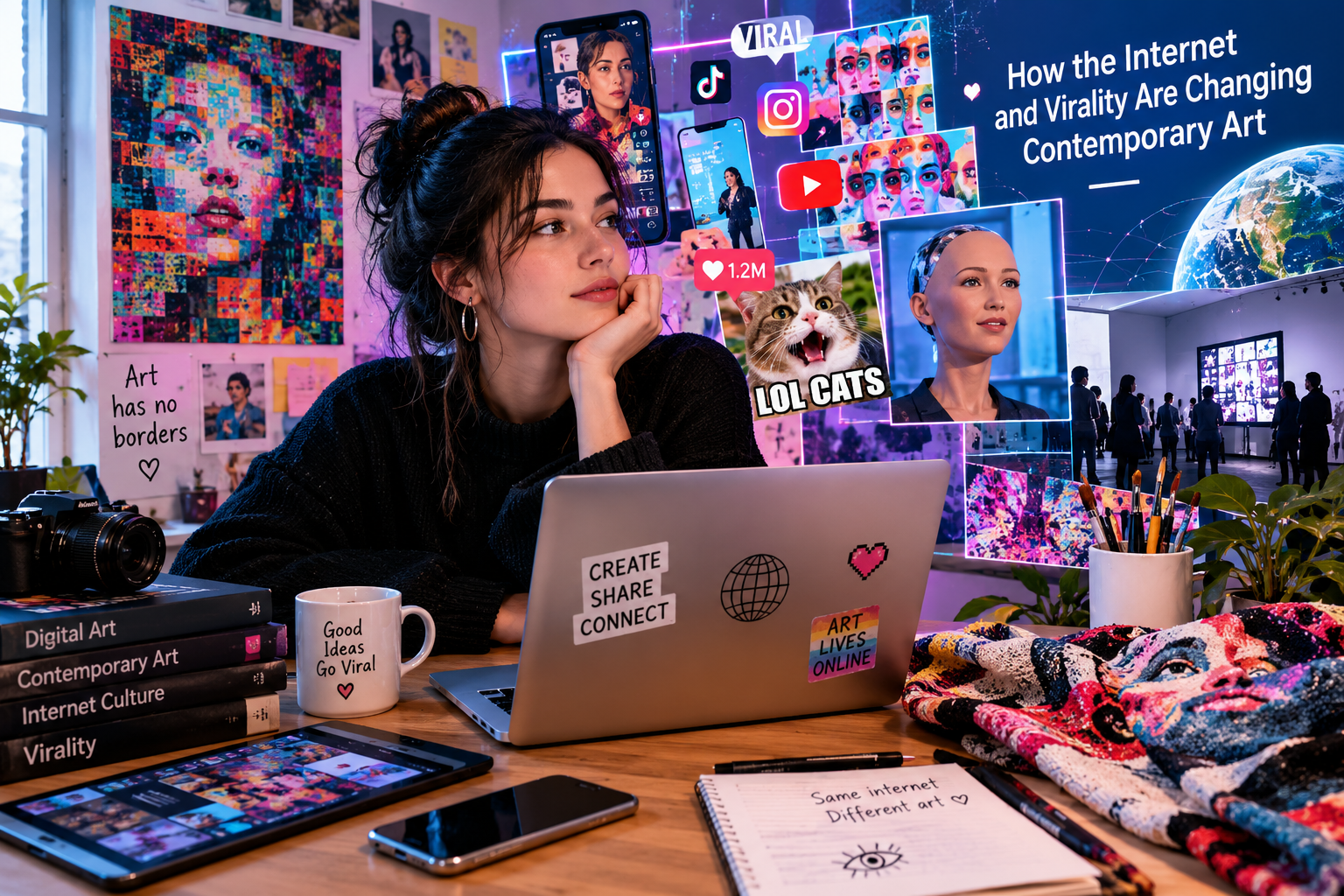
How the Internet and Virality Are Changing Contemporary Art
Art Is No Longer Confined to Traditional Spaces
The digital age has transformed the way people create, share, and experience art. Today, anyone with a smartphone and an internet connection can create artwork and share it with a global audience. Artists no longer need traditional galleries or expensive equipment to express their ideas.
As an artist, I create textile pieces using internet imagery and produce short videos that combine digital content with analog illusions. Other social media users often clip, repost, and remix my work. Whether they realize it or not, they also participate in the collaborative process of creating digital art.
Virality Is Not Always an Accident
Have you ever wondered what makes something spread across the internet and become viral in both digital and physical spaces? I have explored this question through my own work and experiences.
People have clipped and reposted my face countless times, spreading my image across different platforms. These events have shown me that virality can become a powerful artistic tool rather than just an unpredictable online phenomenon.
Virality Has Become an Artistic Medium
Artists are developing a new medium for fine art: virality. Instead of treating social media as a place to upload finished work, some artists use the platforms themselves as their creative material.
Traditional artists work with paint, clay, or other physical materials. Digital artists can work with circulation, attention, repetition, and audience participation. They can transform the way people share and interpret content into an essential part of their artwork.
Virality Can Be a Gift
The internet has several problems. People spend hours doom-scrolling, corporations collect personal data, and extremist groups use mainstream platforms to spread their messages. However, the internet also creates valuable opportunities for artists and communities.
Virality can help artists reach millions of people, introduce new ideas, and build communities that traditional institutions might overlook. When artists use it creatively, the internet can become a powerful tool for artistic expression.
Sophia the Robot: A Digital Cultural Icon
Consider Sophia the robot, for example. For approximately a decade, Sophia has appeared in numerous viral videos that blur the boundaries between human identity and robotic technology.
People have repeatedly shared, edited, and turned these videos into memes. This constant circulation has helped establish Sophia as a recognizable cultural icon.
Her popularity demonstrates how internet users can shape the meaning and public image of a subject through repetition, humor, and online discussion.
The Internet Makes Art More Accessible
I see a connection between Sophia and humanity, not only because she has become a cultural icon but also because the internet has played an important role in my own life.
As a deaf and hard-of-hearing person, I rely on digital accessibility features such as captions and automatic text. These tools have made communication much easier for me. I also use my phone to adjust my hearing aids to suit different environments.
For many marginalized communities, the internet provides access, visibility, and opportunities that traditional spaces may not offer. Technology continues to influence our bodies, culture, communication, and the ways we create art.
Let’s explore some unexpected ways the internet has transformed contemporary art.
Artists Have Used Technology for Decades
Artists began experimenting with technology long before social media became popular.
During the 1960s, Nam June Paik arranged televisions into sculptural installations and explored the artistic possibilities of video. In the 1980s, Pipilotti Rist used video projections and moving images to challenge conventional representations of women.
At the time, many people questioned whether these experimental works qualified as art. However, artists continued exploring new techniques and expanded the possibilities of contemporary artistic expression.
Today, museums and galleries recognize video art as a legitimate art form. This history raises an interesting question: Where will internet-based and viral art stand ten years from now?
An iPhone and an Idea Can Start an Art Career
One of the internet’s greatest contributions to fine art is accessibility. Digital platforms have lowered the barriers that once prevented many people from entering the art world.
Artists no longer need to secure gallery space before sharing their work. They can use a smartphone, develop an idea, and publish their creations online.
The internet began as a military research project. During the 1990s, it developed into a more visual and interactive environment where people could explore websites, join fandoms, and discover digital art.
As these online spaces expanded, artists began experimenting with new ways to create, display, and distribute their work.
Tumblr Images Became Part of Fine Art
As internet culture grew, people began discussing whether digital images and online content could qualify as fine art. The post-internet art movement embraced these questions and explored creative practices that moved beyond traditional categories such as painting and sculpture.
The movement reflected a world in which digital technology influenced nearly every aspect of everyday life, including how artists developed ideas and presented their work.
I started experimenting with internet art when I was in middle school. I posted fan fiction and emotional anime drawings online. Although I sometimes felt embarrassed by those early creations, an anonymous online audience welcomed my work.
That experience showed me how easily the internet could connect creators with people who shared their interests. Its affordability and ease of use opened new possibilities for aspiring artists.
YouTube Created New Opportunities for Performance Art
YouTube also changed the way artists create and distribute their work. The platform gave creators an accessible space where they could upload long-form videos, document performances, and share experimental projects with viewers around the world.
Artists could reach audiences without relying entirely on established galleries or institutions. They could also connect with other creators, gallery owners, collectors, and potential collaborators.
This connectivity helped artists discover new opportunities and build audiences beyond their local communities.
Social Media Built New Creative Communities
MySpace launched in 2003, and Facebook followed in 2004. These platforms helped establish the social media culture that shapes online communication today.
As more people joined these networks, online communities grew rapidly. Marginalized and underrepresented groups, including queer communities, used these platforms to find support, share experiences, and express themselves.
The internet also gave people more freedom to explore and present their identities. At one point, I presented myself online as a 15-year-old boy from London, although I was actually a 12-year-old girl from Los Angeles. Later, I identified as a non-binary lesbian in real life.
These experiences demonstrate how digital spaces can allow people to experiment with identity and discover communities where they feel understood.
Lonelygirl15 Showed the Power of Online Storytelling
In 2006, the web series Lonelygirl15 attracted enormous attention on YouTube. The series featured a girl speaking directly to the camera, and viewers followed her story through regular video uploads.
I watched every episode and joined other viewers who discussed the story in YouTube comments and on Reddit. Many of us became concerned when the character appeared to become involved with a dangerous cult. We even discussed how we could help her.
Eventually, people discovered that a production company had created the series as a fictional project.
This revelation demonstrated how creators could use the internet to develop fictional identities, tell compelling stories, and attract massive audiences. Young artists realized that they could invent characters, build narratives, and publish their ideas without first receiving approval from traditional media organizations.
Memes Became a New Form of Digital Expression
Around the same period, memes became a major part of internet culture. Online communities developed their own visual language, using humor, captions, familiar images, and repeated references to communicate ideas.
The word meme comes from the concept of imitation and cultural transmission. Before the internet, researchers used the term to describe units of culture that spread from person to person.
Internet users adapted this concept through images, jokes, videos, and other forms of shareable content.
LOLcats Helped Shape Internet Art
In the early 2000s, LOLcats became a popular internet phenomenon. People added intentionally misspelled captions to photographs of cats and shared the resulting images online.
Although many people considered these images silly or embarrassing, they helped establish a creative culture in which anyone could take an existing image, add a new meaning, and distribute the result.
This practice gave meme creators a platform to experiment with humor, visual communication, and collaborative creativity.
Marcel Duchamp Inspired the Idea of Digital Readymades
In 1917, artist Marcel Duchamp submitted a urinal to an art exhibition. He did not manufacture the object himself. Instead, he selected it, reframed it, gave it a title, and presented it as art.
Duchamp’s approach helped establish the concept of the readymade: an existing, often mass-produced object that an artist transforms into an artwork through selection and presentation.
Early internet meme creators followed a similar approach. They often took existing photographs or images rather than creating every element from scratch. By adding captions, changing the context, and sharing the results, they transformed ordinary images into new cultural expressions.
This practice helped later scholars recognize early internet memes as a form of folk art.
The Internet Became a Marketplace for Art
The internet also transformed the business side of the art world. In 2007, the LOLcats website reportedly sold for $2 million, illustrating the commercial value that online culture could generate.
Platforms such as Artsy also made it easier for collectors to discover artists and explore artworks without visiting physical galleries.
Artists and collectors could connect online, view available works, and discover opportunities across geographical boundaries. As a result, the internet evolved from a space for communication and expression into a marketplace for art and creative products.
Instagram Changed the Way Artists Create
Instagram launched in 2010 and encouraged artists to think about how their work would appear on smartphone screens.
Many artists began using brighter colors, stronger compositions, and eye-catching visuals to capture attention as people scrolled through their feeds.
Even artists who exhibited their work in physical galleries recognized that online audiences would encounter many of their creations through digital images. Artists therefore began considering the mobile viewing experience as an important part of their creative process.
Amalia Ulman Turned Instagram Into a Performance
In 2014, artist Amalia Ulman created an Instagram performance that presented her as a lifestyle influencer. She shared beauty routines, thanked her followers, and posted about undergoing plastic surgery. Her online character eventually appeared to experience a personal crisis.
Ulman carefully constructed the story rather than documenting a genuine sequence of events. Through this project, she criticized the way social media encouraged people to turn women’s lives, appearances, and personal experiences into entertainment and commodities.
Her work also demonstrated that artists could use the internet itself as a performance space. Instead of presenting a live performance in a traditional venue, an artist could develop a character, publish a sequence of posts, and let an online audience experience the performance over time.
The Internet Became the Medium Itself
The internet has influenced contemporary art in countless ways. Artists have used it not only to display finished work but also to create experiences that depend on digital platforms.
Online circulation, audience reactions, comments, reposts, and changing interpretations can all become part of an artwork. In these cases, the internet does not simply distribute the art; it actively shapes the artistic process.
This shift represents one of the most important developments in contemporary digital creativity.
From Creative Expression to the Attention Economy
Over roughly two decades, the internet has changed from a space for personal expression into an environment that often rewards attention and commercial activity.
Content creators increasingly build personal brands to attract clicks, views, sponsorships, and advertising opportunities. Social media platforms encourage users to compete for visibility, and this pressure can influence what creators produce.
However, artists can still reclaim the internet as a creative studio rather than treating it exclusively as a marketplace.
During the COVID-19 pandemic, artists moved much of their work online. TikTok expanded, Instagram introduced Reels, and creators experimented with new formats and styles. These developments renewed interest in the spontaneous, experimental creativity that characterized early internet culture.
Attention Economy: When Scrolling Becomes Art
In 2025, artist Qualicia Wood presented a performance titled Attention Economy. She lay in a bed inside a gallery and scrolled through her phone.
The scrolling itself formed the performance. Instead of using a conventional artistic object, Wood made an everyday digital behavior the central element of her work.
Her performance encouraged viewers to consider how much time and attention people give to digital platforms. It also demonstrated how artists can transform ordinary online habits into meaningful artistic experiences.
The work reflects the relevance of Andy Warhol’s ideas about popular culture, mass media, and everyday life in the digital age.
Digital Refusal: Reclaiming the Internet
Artist, curator, and writer Legacy Russell explores the concept of digital refusal. This idea encourages people to challenge the expectations and conventions that shape online spaces.
Digital refusal does not necessarily mean abandoning the internet or simply reducing screen time. Instead, it encourages people to question digital norms and find different ways to participate.
Artists can use this approach to challenge familiar online behaviors, experiment with alternative forms of expression, and create work that does not follow the usual rules of social media.
Introduce a Glitch Into the Algorithm
Artists can reclaim digital spaces by presenting ideas in unexpected ways. They can challenge familiar formats, disrupt audience expectations, and experiment with content that resists conventional social media trends.
For example, I sometimes introduce a visual or conceptual glitch into my videos to interrupt the usual flow of online content. I might present an ordinary object in an unusual way, encouraging viewers to question what they see.
In one example, I printed an image of a microphone rather than using a real microphone. This small creative decision challenged expectations and turned an ordinary object into an unexpected artistic element.
Artists can use similar techniques to explore new possibilities and make audiences reconsider familiar digital experiences.
Turn the Internet Into a Sketchbook or Digital Canvas
How can we transform the internet from a place dominated by transactions and attention-seeking into a space for creativity?
We can start by accepting that making art online often feels awkward or embarrassing. Many early internet trends, including amateur drawings, unusual memes, and experimental videos, looked imperfect. Yet those experiments helped shape the culture we enjoy today.
Artists do not need to create flawless work before sharing it. They can experiment, make mistakes, explore unfamiliar ideas, and learn through the process.
When creators stop worrying so much about appearing perfect, they can give themselves more freedom to develop original ideas.
Being an Artist Has Always Required Courage
Sharing art requires vulnerability. Artists expose their ideas to appreciation, criticism, misunderstanding, and judgment.
The internet has not created this challenge; it has simply expanded the audience that can respond to creative work.
If you feel nervous about sharing your art online, remember that experimentation has always been part of artistic practice. You do not need to impress everyone or follow every trend to make meaningful work.
Instead, focus on expressing your ideas, learning new techniques, and connecting with people who appreciate your perspective.
Post Your Work and Walk Away
You can reclaim the internet as your digital canvas, sketchbook, and creative studio by changing the way you approach it.
Create digital personas, build communities, experiment with unconventional ideas, and make imperfect art simply because you enjoy the process. Allow yourself to explore without measuring every creation by its views, likes, or potential earnings.
You can also develop a healthier relationship with social media by sharing your work without constantly checking how people respond.
The internet offers artists an extraordinary opportunity to create, collaborate, and reach audiences around the world. When we use these platforms with curiosity and intention, we can turn digital spaces into places of genuine artistic expression.
Create boldly, embrace experimentation, connect with others, and remember that the creative process matters just as much as the finished work. Post your art, then walk away and keep creating.